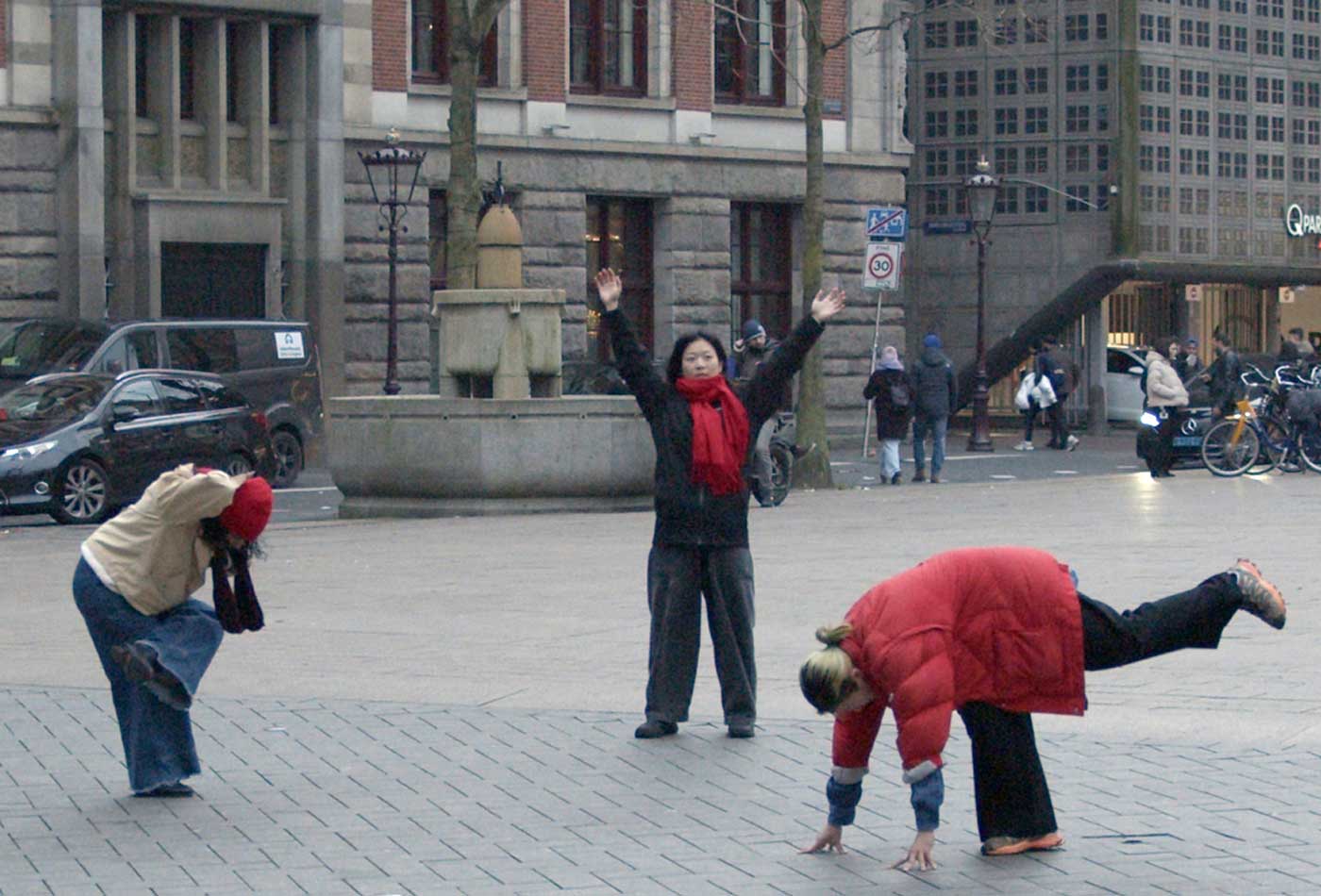
Textura (Spui 130)
Lila de Coninck, Ael Diet, Fabianna Florez Sanchez, Hara Ghan, Lawrence McGuire, Omid Nemalhabib, Soyun Park, Anna Schmitz & Wiebke Stadtlander
29.08.2026 — 25.10.2026
West Den Haag at Spui 130, The Hague
Textura is an international transdisciplinary project by West Den Haag that approaches art from a philosophical and theoretical perspective. Philosophy is not used as an explanation of art, but as a method for questioning existing concepts, shifting boundaries and inviting new insights. The starting point for Textura 2026 is the concept of ‘worlding’, with a particular focus on the work of philosopher Gayatri Chakravorty Spivak.
From this perspective, Textura brings together artists, writers, thinkers and other practitioners from different disciplines and contexts. The project is grounded in the idea that difference and contradiction are not opposed to art, but lie at its very origin. Where perspectives diverge, space emerges for art, where meanings shift and existing forms can be opened up.
The title Textura refers to the Latin word for fabric or structure, which is at the root of the project’s curatorial starting point. Each contribution is deliberately presented as an autonomous practice, while the encounters, resonances and tensions between the different works and disciplines create the coherence of the project. Some connections are immediately visible, while others only emerge through the visitor’s subsequent experience. Textura brings together different moments within West’s programme. Some participants have previously presented work at West and return in a new constellation. Others are introduced through the project and will be explored more extensively in the future. New artists will also be added to the programme. In this way, Textura connects not only different practices, but also past, present and future. The diverse backgrounds and working methods of the artists are not brought together under a single definition of art. Rather, it is precisely the coexistence of different artistic, literary and intellectual positions that forms the starting point of Textura.
The project is part of our four-year research programme ‘Worlding Art’. Through this programme, West explores art as a social and human phenomenon that is not determined solely by artists or institutions. Visitors, communities, histories and broader cultural understandings also contribute to what is considered art, its meanings and the ways in which the concept of art is defined and bounded. The concept of ‘worlding’ offers a way of understanding the world, not as something fixed, but as something continually shaped through relationships, perspectives and processes of making-meaning. From this perspective, Textura asks not only what art is, but above all how new art worlds come into being.
This openness shapes the form of the project. Parallel presentations form its starting point, while Textura will keep developing through publications, conversations, symposia, performances and other public programmes. It is a structure to grow, shift and form new relationships. Textura unfolds across different locations in The Hague. The project takes place at West’s current premises, the former US Embassy on Lange Voorhout, and at Spui 130, future permanent location of West Den Haag. At Spui 130, West is presenting a temporary programme under the name ‘Testforum’ until the building is renovated. By connecting the two locations, the transition from the current West to the future West becomes part of Textura as well.
Textura thus approaches art as a polyphonic practice in which difference, contradiction and renewal are not additional characteristics, but conditions for the existence of art. Where meaning becomes fixed and the possibility of various perspectives disappears, art itself ceases to exist.
Participating artists
Mina Calori is a fashion designer. For her collection ‘The Soaring of the Simorgh’, she combines soft wool with sharp laser-cut incisions and striking shoes with beak-shaped toes, through which she depicts the process of ‘shedding’, a symbol of growth and transformation. With her work, she explores universal themes such as migration and the construction of identity.
Lila Maria de Coninck simulates multilingual confusion in her work by playing with sound, rhythm and (mis)communication. Through poetic constructions of linguistic failure, she reflects on underlying meanings and (lost) nuances. In doing so, she attempts to deconstruct language and the reality to which it refers. Her performance ‘Learning Langue with Love’ is a reinterpretation of a language course inspired by a pseudoscientific learning method known as ‘Suggestopedia’.
Ael Died slows down the navigation of the internet by building search engines, servers, archives, games, websites, and instruments. In his work, he considers the internet unfinished— a place that can be continuously rearranged, repaired, maintained, misused, and shared.
Fabianna Flores Sanchez’ work draws on folklore and archival material. She interweaves fiction and non-fiction to explore how stories from the past influence the present, and how they become intertwined with politics and history. In The Shapeshifting of El Silbón, she draws on ghost stories, such as the legend of El Silbón (The Whistler). This legend originated in the mid-19th century and has been passed down orally through generations in Venezuela. Sanchez’s film shows how systems of exploitation and power reappear over time, shaping the relationships between people, land, and animals.
Hara Ghan is a photographer who documents specific individuals and social groups on the margins of normative representation. ‘Strays’ is an autobiographical documentary that encompasses squatters, punks and ravers, as well as gender-nonconforming sex workers and people struggling with mental health issues and/ or substance abuse.
Lawrence McGuire works with text-sound, text-based print, and phonetic play. He presents his work both live and fixed, using voice in both acoustic and synthetic forms. His work moves between the text-sound practices of sound poets and the machinic thinking characteristic of computer music and science.
Omid Nemalhabib works at the intersection of graphic design, type design, visual language, and multilingual typography. Drawing on philosophy, critical theory, poetry, and practice-based research, he develops typographic systems. His work emerges from the ongoing dialogue between analogue making and digital experiment.
Soyun Park is a South Korean artist, filmmaker, and researcher. She critically examines the political structures of machine-learning systems embedded in the body. Moving between dreams, machine vision, and choreography, she uses play, glitching, and collective imagination. ‘The Neighbour (ongoing research)’ is a cinematic journey in which the machine is misled.
Anna Schmitz explores spatial design through video installations, urban interventions, and material-based practice. She works at the intersection of narration and cultural heritage, with a particular interest in local traditions, craftsmanship, and regional architecture.
Wiebke Stadtlander is a PhD researcher in the Department of Urban and Regional Planning and Geo-Information Management at the University of Twente, where she examines built environments through an intersectional feminist perspective on care. In her project, she explores how spaces can be designed to hack the systematic, temporary homelessness experienced by ‘fluidly housed youth’.
This exhibition is curated by Nele Brökelmann and Marie-José Sondeijker.
For more information, please contact Emma Wiersma at press@westdenhaag.nl or +31 6 20661122.
Supported by the Municipality of The Hague and the Dutch Ministry of Education, Culture and Science (OCW).