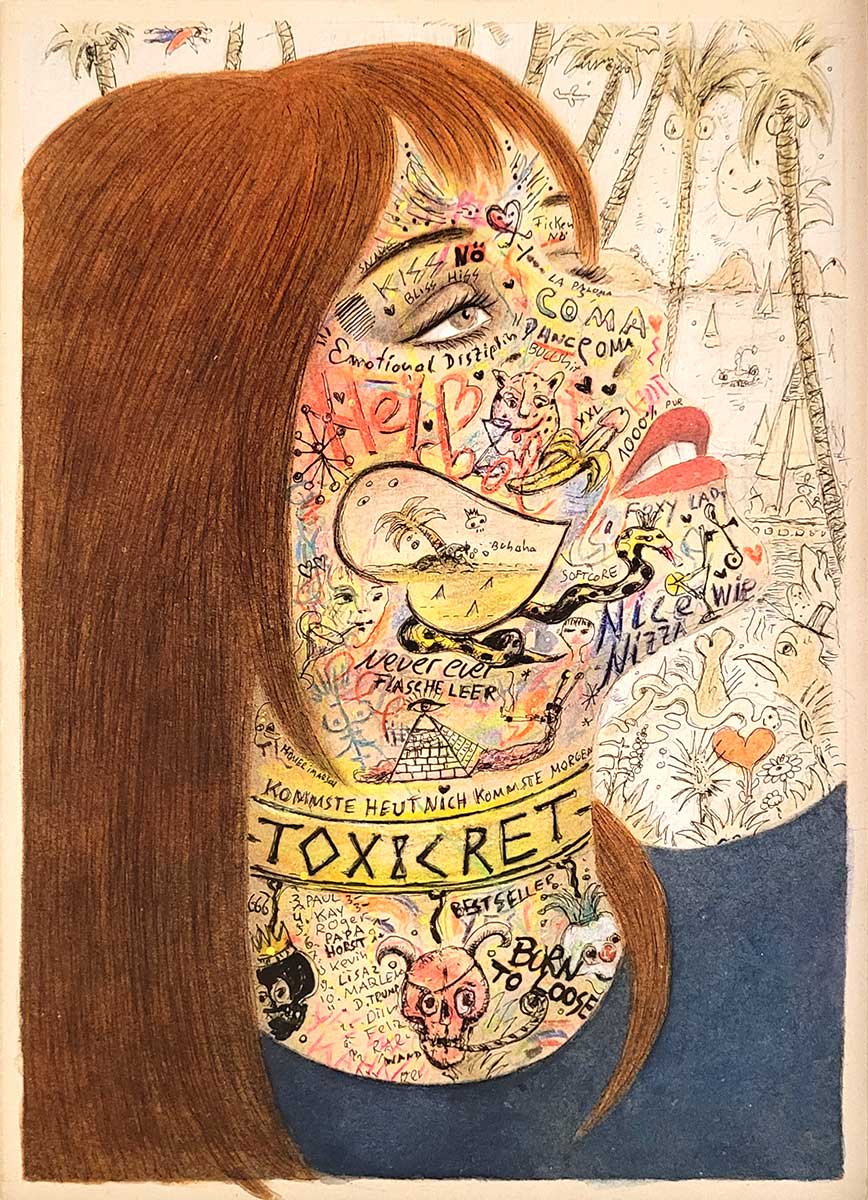
Sebastiaan Schlicher (1975) lived and worked in Berlin from 2006 to 2013. Last year, he conceived the idea for an exhibition bringing together artists he met during his Berlin years, alongside more recent Berlin connections and Dutch artists who share a similar mentality and thematic approach. The title refers to Rainer Werner Fassbinder’s 1976 film Satansbraten, while also carrying the meaning of “rascal” or enfant terrible, a badge of honour for the artist who navigates and survives in the Grossstadt.
Schlicher himself wrote the following tongue-in-cheek statement for the exhibition:
“Satansbraten (after the film by R.W. Fassbinder) refers to the Gesunde(s) Volksempfinden surrounding art and artists, and anticipates the growing awareness that visual art which has nothing constructive to communicate might as well be abolished.”
Many of the Berlin-based artists bring together a raw edge with a sense of humour. Jan Brokof (1977), represented by Galerie Maurits van de Laar since 2008, gives the subject of cannibalism a contemporary political dimension. In exuberant fluorescent colours, Philip Grözinger (1972) creates paintings and ceramic works that evoke an apparently cheerful yet grotesque world in which social issues subtly emerge. His ceramic hot dog — both playful and slightly claustrophobic — stands for an endless appetite for more. Emily Hunt (1981), an Australian artist living and working in Berlin, creates baroque ceramic sculptures connected to themes of esotericism and magic. Among the works presented is a ceramic psychiatrist and patient seated on a dollhouse chair and sofa she found at a Berlin Flohmarkt.