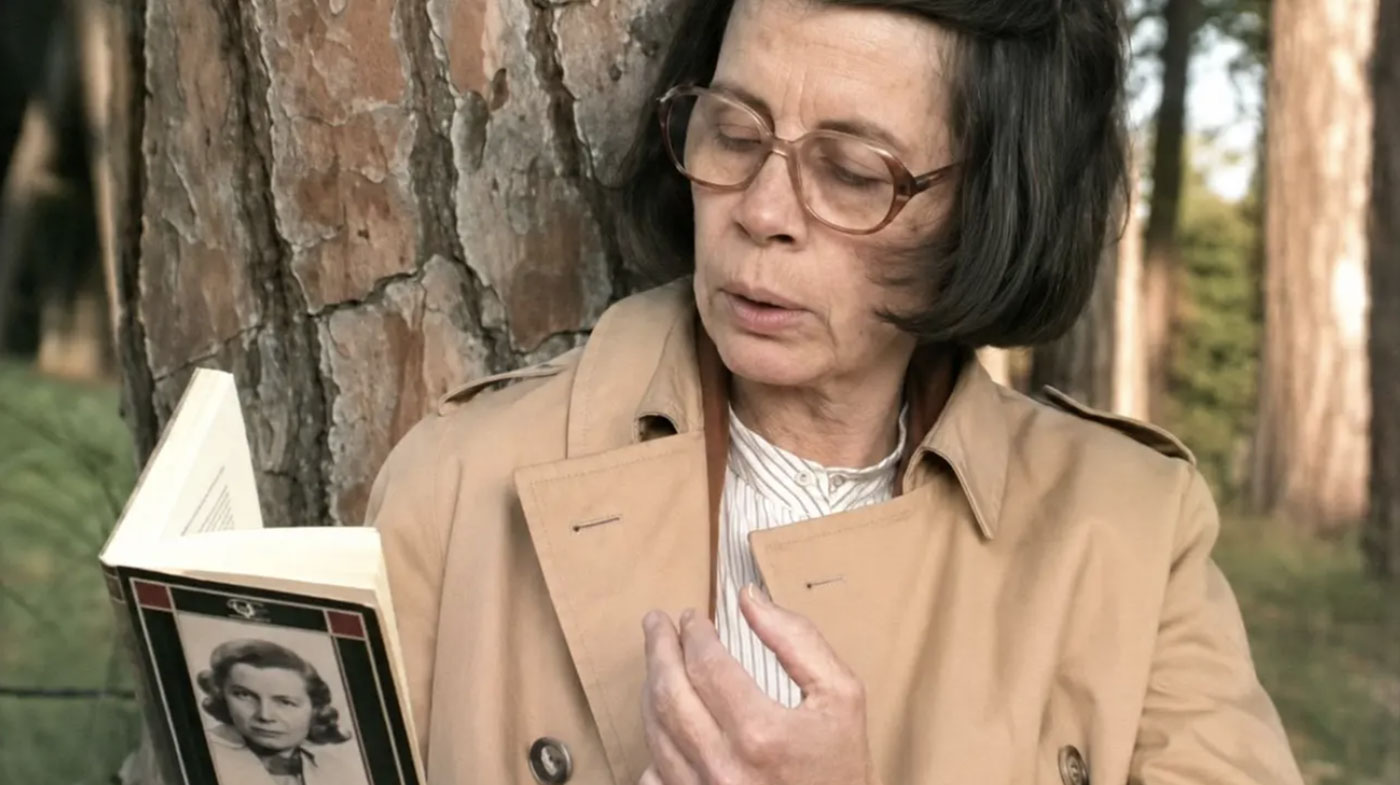
‘In the babbler / that lives I demand to be inscribed.’ With this oblique line from her 1953 collection Variazioni belliche, Amelia Rosselli imagines inscription not as the fixing of language, but as the desire to enter a living, unstable field of voices. To be inscribed is not simply to write: it is to inhabit language and history, to transform them from within while submitting oneself to the rhythms, memories, and forms that belong to a historical unconscious.
The exhibition explores inscription as a material and medial practice across Rosselli’s work, through manuscripts, typescripts, annotated books, sound recordings, and printed pages. Every passage – between stages of writing, speech and text, typescript and print, ‘muscular movements and mental forms’ – produces not a faithful copy but a new inscription, marked by delay, translation, and variation. The same movement traverses Rosselli’s multilingual writing. Composing in Italian, English, and French, she simultaneously inhabits and unsettles the canonical rhythms and syntactic orders through which each language is conventionally inscribed. Rather than moving between discrete linguistic systems, Rosselli allows their prosodies to interfere and resonate, writing herself into each tradition precisely by displacing its inherited measures.
Rosselli repeatedly insisted that poetic form could not be separated from its sonic life. Her metric experiments sought to give ‘equal sonic and graphic space to the letter,’ refusing any simple opposition between what is heard and what is seen. The exhibition follows these crossings between sound and page through practices of poetic notation, ethnographic transcription, and lyric transmission.
‘In the babbler / that lives I demand to be inscribed’ is curated by zero sharp (Maximilian Gillessen & Anton Stuckardt) and Andrea di Serego Alighieri.
zero sharp is a Berlin-based publishing imprint that focuses on translating literature that goes beyond conventional narrative forms. Next to a focus on predecessors of the Avantgarde such as Raymond Roussel, René Daumal or Jean-Pierre Brisset, zero sharp works on the translation and publication of lesser known poetic voices. For the Alphabetum they have previously curated the exhibition Roussel/Brisset/Duchamp – Engineers of the Infra-thin and Mount Analogue Observatory.
Andrea di Serego Alighieri is a writer and teacher. He is a lecturer in writing and typography at the Royal Academy of Fine Arts Antwerp and a PhD candidate in Medieval and Modern Languages at the University of Oxford with a thesis on Amelia Rosselli and Kamau Brathwaite.
Amelia Rosselli (Paris, 28 March 1930 – Rome, 11 February 1996) holds an irreducible place within twentieth-century poetry. Daughter of the anti-fascist intellectuals Carlo Rosselli and Marion Cave, she grew up across geographical and linguistic borders, shaped by exile and by the experience of moving between discrete histories and biographies. A trilingual poet writing in Italian, English, and French, and a musicologist with a rigorous engagement with sound, rhythm, and form, Rosselli was well attuned to the debates and transformations of twentieth-century musical modernism, such as atonality and serialism. This engagement informed a body of work that resists affiliation with any single linguistic or literary tradition. As she wrote towards the end of Variazioni belliche: ‘I rhyme for another century’.