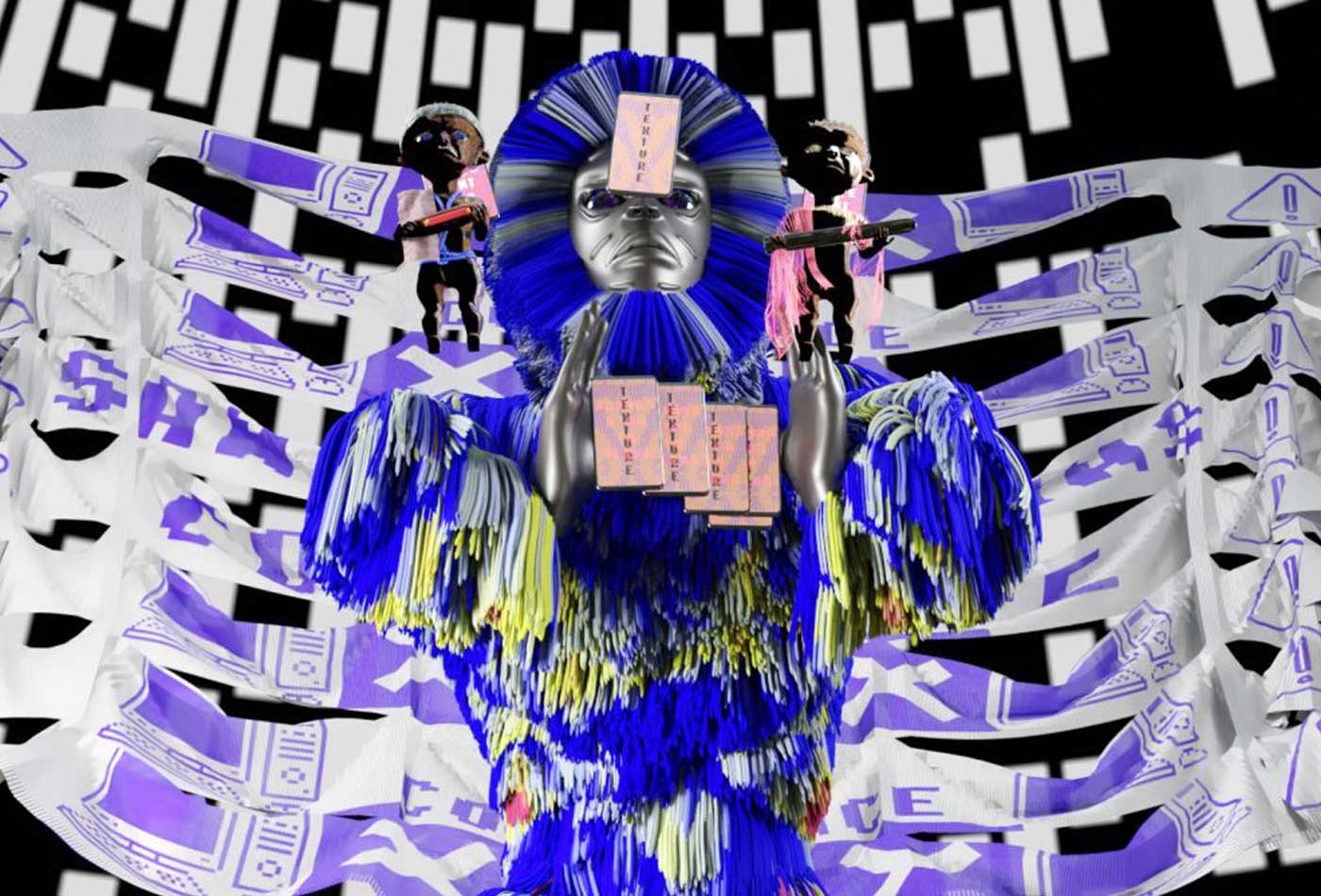
Textura (Lange Voorhout 102)
Hoda Afshar, Diane Cescutti, Koenraad Dedobbeleer, Lynnée Denise, Florian Hecker & Marcin Pietruszewski, Josh Kline, Sondra Perry, Johann Wilhelm Ritter
05.09.2026 — 26.12.2026
05.09.2026, 19:00 hrs.
West Den Haag in the former American Embassy, Lange Voorhout 102, The Hague
Textura is an international transdisciplinary project by West Den Haag that approaches art from a philosophical and theoretical perspective. Philosophy is not used as an explanation of art, but as a method for questioning existing concepts, shifting boundaries and inviting new insights. The starting point for Textura 2026 is the concept of ‘worlding’, with a particular focus on the work of philosopher Gayatri Chakravorty Spivak.
From this perspective, Textura brings together artists, writers, thinkers and other practitioners from different disciplines and contexts. The project is grounded in the idea that difference and contradiction are not opposed to art, but lie at its very origin. Where perspectives diverge, space emerges for art, where meanings shift and existing forms can be opened up.
The title Textura refers to the Latin word for fabric or structure, which is at the root of the project’s curatorial starting point. Each contribution is deliberately presented as an autonomous practice, while the encounters, resonances and tensions between the different works and disciplines create the coherence of the project. Some connections are immediately visible, while others only emerge through the visitor’s subsequent experience. Textura brings together different moments within West’s programme. Some participants have previously presented work at West and return in a new constellation. Others are introduced through the project and will be explored more extensively in the future. New artists will also be added to the programme. In this way, Textura connects not only different practices, but also past, present and future. The diverse backgrounds and working methods of the artists are not brought together under a single definition of art. Rather, it is precisely the coexistence of different artistic, literary and intellectual positions that forms the starting point of Textura.
The project is part of our four-year research programme ‘Worlding Art’. Through this programme, West explores art as a social and human phenomenon that is not determined solely by artists or institutions. Visitors, communities, histories and broader cultural understandings also contribute to what is considered art, its meanings and the ways in which the concept of art is defined and bounded. The concept of ‘worlding’ offers a way of understanding the world, not as something fixed, but as something continually shaped through relationships, perspectives and processes of making-meaning. From this perspective, Textura asks not only what art is, but above all how new art worlds come into being.
This openness shapes the form of the project. Parallel presentations form its starting point, while Textura will keep developing through publications, conversations, symposia, performances and other public programmes. It is a structure to grow, shift and form new relationships.
Textura unfolds across different locations in The Hague. The project takes place at West’s current premises, the former US Embassy on Lange Voorhout, and at Spui 130, future permanent location of West Den Haag. At Spui 130, West is presenting a temporary programme under the name ‘Testforum’ until the building is renovated. By connecting the two locations, the transition from the current West to the future West becomes part of Textura as well.
Textura thus approaches art as a polyphonic practice in which difference, contradiction and renewal are not additional characteristics, but conditions for the existence of art. Where meaning becomes fixed and the possibility of various perspectives disappears, art itself ceases to exist.
Participating artists:
Hoda Afshar is a visual artist whose practice focuses on the intricate relationships between politics and aesthetics, knowledge and representation, visibility and violence. She is interested in the ways that image-making can either reinforce or challenge our common sense, and the forces that shape perception. Her works invite audiences to reflect on and to rethink how and what we see, often by drawing attention to parts of the political and visible order that have previously been excluded.
Diane Cescutti is a transmedia artist. Her practice takes as its starting point the loom that gave rise to digital computing. She pulls the threads from the weft of her computer screen and traces them back to her loom. She searches for the source code, the re-source. Through a speculative, histofuturistic and narrative approach, she explores the historical, technological, mathematical and aesthetic links between weaving, textiles, computers and digital technology.
Koenraad Dedobbeleer is known for his sculptures and installations in which everyday objects are modified, assembled, and recontextualized. His works can be seen as joyful collisions of language and matter. Yet, this approach is not merely an act of formal entertainment. Nourished by an in-depth knowledge of art history and (seemingly) inexhaustible technical resources, the artist’s work establishes an ongoing dialogue with a broader tradition of sculpture, including its relation to architecture, industrial design, DIY culture, images, and book making.
Lynnée Denise is a global practitioner of sound, language, and Black Atlantic thought. A writer, researcher, and interdisciplinary artist from Los Angeles, she lives between Amsterdam and Johannesburg. Shaped by her parents’ record collection and the cultural currents of the 1980s, Denise foregrounds the intimacies of underground nightclub movements, music migration, and bass culture across the African Diaspora. Her Black queer research considers sound system culture as a living archive and a site of refuge, tracing how cultural life and memory travel through records, dancefloors, radio waves, and across geography.
Florian Hecker works with synthetic sound, the listening process, and the audience’s auditory experience. Recent exhibitions and performances include FAVN, Terraforma EXO, Milano, 2025, and TEMPLEXTURES, Galerie Neu, Berlin, Germany, 2022. Hecker has an extensive discography, including: Resynthese FAVN (Blank Forms, New York, 2024); Syn As Text [AC] (Etat, Vienna, 2021); and Synopsis Seriation (Editions Mego, Vienna, 2021).
Josh Kline’s art questions how emergent technologies are being used to change human life in the 21st Century. He often utilizes the technologies, practices, and forms he scrutinizes: digitization, data collection, image manipulation, 3D-printing, advertising, productivity-enhancing substances; aiming them back at themselves. Some of his most well-known videos use early deepfake software to speculate on the meaning of truth in a time of post-truth propaganda. At its core, Kline’s practice is focused on work and class, exploring how today’s most urgent social and political issues impact the labor force.
Sondra Perry holds an MFA from Columbia University and a BFA from Alfred University. In 2015, Perry was a panelist at Black Artists on Social Media at the Brooklyn Museum, NY. The artist was a 2021 Visiting Fellow in Fine Arts at Yale University and has participated in residencies at Oxbow, the Experimental Television Center, and the Core Program at the Museum of Fine Arts, Houston. Perry lives and works in New Jersey.
Marcin Pietruszewski is a composer and researcher engaged in sound synthesis and composition with computers, exploring specific formal developments in the tradition of electroacoustic music and contemporary sound art. A recent sound installation—Love Numbers—with Anthea Caddy, was premiered at the Venice Music Biennale 2023, and he also presented commissioned work at Sonic Acts, Amsterdam (2024); CTM Festival, Berlin (2021); and ZKM Karlsruhe, Germany (2018), amongst many others.
Johann Wilhelm Ritter (1776 — 1810) was a German chemist and physicist. Ritter made discoveries in electrochemistry (dry battery), discovered the ultraviolet spectrum of electromagnetic radiation, and was the first to establish an explicit link between galvanism and chemical reactivity. He wrote the ‘Fragmente aus dem Nachlasse eines jungen Physikers. Ein Taschenbuch für Freunde der Natur’. In many of his experiments, he used his own body. He died at a young age, possibly as a result of experiments with electric currents.
This exhibition is curated by Marie-José Sondeijker. For more information, please contact Emma Wiersma at press@westdenhaag.nl or +31 6 20661122. Supported by the Municipality of The Hague and the Dutch Ministry of Education, Culture and Science (OCW).